Autonomous Vehicle Safety: The Cyan Light Dilemma
Federal regulators suggest a standardized blue-green indicator to resolve confusion about driverless cars, while simultaneously relaxing rules for non-human controls.
By Ahmed Peterson ·
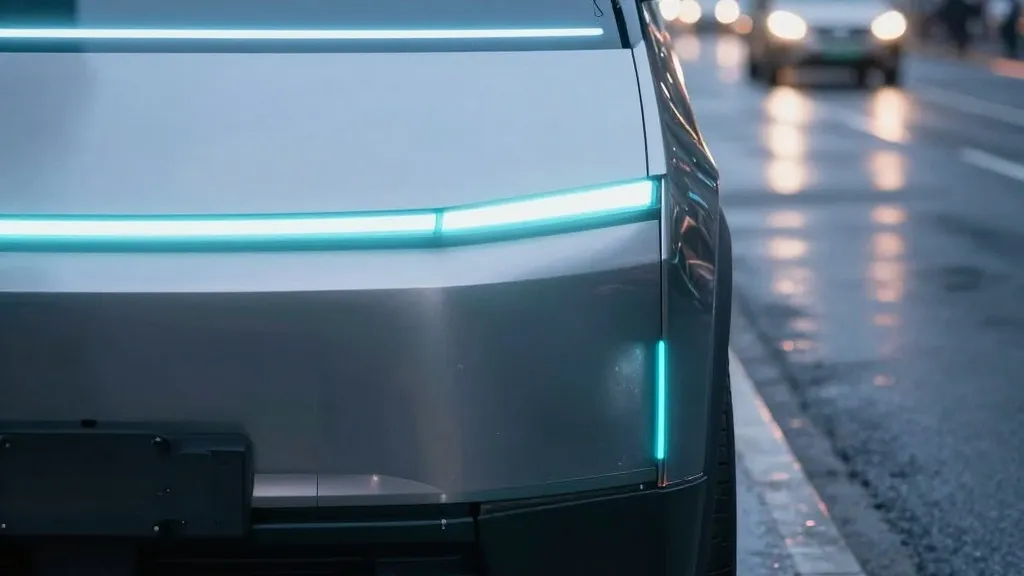
A fundamental tension exists within the current regulatory framework for self-driving technology. On one hand, federal agencies aim to streamline the path for driverless vehicles to reach public roads. On the other hand, strict legacy rules designed for human drivers create friction and safety ambiguities. To bridge this gap, the National Highway Traffic Safety Administration has proposed a specific visual signal: a cyan light that would indicate an automated system is in control. This move seeks to answer a question the industry has struggled to solve for years, ensuring that pedestrians, cyclists, and police officers can instantly distinguish a robotaxi from a conventional car.
The proposed amendments to Federal Motor Vehicle Safety Standard No. 108 target vehicle lighting regulations specifically for autonomous platforms. The agency argues that the color cyan fills a critical visual void. Existing automotive lighting already utilizes red, amber, white, and flashing blue or red tones for standard functions like braking, turning, and emergency services. By introducing a distinct blue-green hue, regulators hope to create a clear, consistent signal that reduces the risk of misinterpretation on crowded streets. The proposal is not mandatory for all manufacturers, but it would establish a uniform federal standard for any company that chooses to adopt the technology.
There is historical context for this specific color choice, though its application has shifted. Mercedes-Benz previously secured state-level approval for turquoise markers on its Level 3 Drive Pilot vehicles. However, the automaker later pivoted to a Level 2++ system, abandoning the earlier approach. Despite this corporate shift, NHTSA is pushing for a national framework that allows diverse players, including Waymo, Nuro, Zoox, GM, and Mercedes, to use identical lighting configurations. This standardization aims to prevent a fragmented landscape where different companies use varying colors and signals, which could confuse road users who are already adjusting to new technology.
Beyond the external markers, the proposal addresses internal components that are often irrelevant in a driverless context. Current regulations require physical hardware such as hazard switches, manual beam shifters, and turn levers. NHTSA proposes removing these requirements, acknowledging that a vehicle without a human driver does not need manual controls for these functions. The agency also plans to update testing standards to accommodate modern LED systems, potentially eliminating administrative hurdles. Additionally, regulators are considering dropping rules that dictate the specific vertical placement of high-beam lights relative to low-beam lights, further simplifying the design process for autonomous manufacturers.
This initiative is part of a broader Department of Transportation effort to accelerate the deployment of self-driving cars. The goal is to ease the regulatory burden on automakers designing vehicles without traditional controls like steering wheels and pedals. However, the transition is not immediate. Regulators continue to enforce existing rules as they are currently written, creating a complex interim period for companies like Tesla. Last month, NHTSA opened an audit query regarding the Tesla Cybercab, examining the technical data used for its certification. The agency’s concern centers on the vehicle’s lack of sideview mirrors, pedals, and a steering wheel, features that remain mandatory under the current federal standards despite the new proposals for the future.
Source: The Verge