Crows Solve Visual Puzzles With Primate Logic at Double Speed
New research reveals that avian brains use the same decision-making algorithms as primates, despite lacking a neocortex, and they process information significantly faster.
By Ahmed Peterson ·
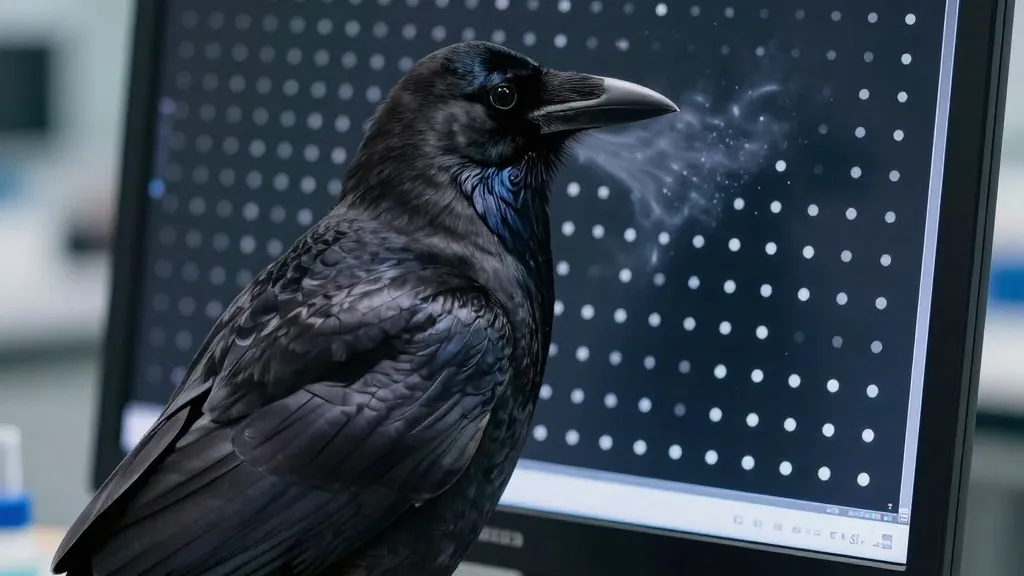
Carrion crows make decisions using the same mathematical logic as primates, yet they complete these cognitive tasks twice as fast. This finding challenges long-held assumptions about how different brain structures process information. It suggests that the specific architecture of the brain matters less than the underlying algorithmic principles used to gather and weigh evidence.
The study utilized the random-dot-motion task, a standard method in neuroscience for measuring decision-making. In this test, a subject observes a cloud of flickering specks that drift weakly in a single direction. The subject must determine if movement exists and identify the direction. In primates, this process involves neurons in the neocortex collecting visual evidence over time. Their firing rates increase until they cross a specific threshold, at which point the animal commits to a choice. Because birds lack a neocortex, scientists had previously been uncertain about how avian brains handled similar complex decisions.
Andreas Nieder, a neurobiologist at the University of Tübingen, described this structural difference as the central mystery of the research. He noted, "This was the big question. How [would] a differently organized avian brain encode decisions?" To address this, Nieder and his colleague Philipp Schmidbauer conducted experiments with two hand-raised carrion crows. The researchers recorded the birds' brain activity while they performed the task on a touch-sensitive monitor displaying white dots on a black background. The crows indicated their chosen direction by pecking targets flanking the display, receiving a mealworm for each correct answer.
The experimental setup was designed to be identical to the version used with monkeys to ensure a direct comparison. Nieder emphasized this deliberate choice, stating, "We intentionally wanted to have exactly the same random-dot motion task. The only difference was that the crows had to peck to indicate their decision, whereas monkeys were indicating by making an eye movement." The team varied the difficulty of the task by adjusting the percentage of dots that moved coherently. At the easiest level, 81 percent of the dots moved together, making the direction obvious. At the hardest level, only 3 percent moved coherently, making the signal barely distinguishable from random noise. A zero percent condition was also included, where no correct answer existed.
The results showed that the crows solved the task using the same fundamental logic observed in primates. Despite the significant differences in brain organization, the birds arrived at decisions through a comparable process of evidence accumulation. However, the speed of this process was markedly different. The crows completed the decision-making process twice as quickly as the monkeys. This indicates that a brain without a neocortex is fully capable of executing complex decision-making algorithms with high efficiency.
This discovery has significant implications for understanding the evolution of intelligence. It suggests that different species may converge on similar cognitive solutions to environmental challenges, even when their neural hardware varies. The fact that crows achieve this at a faster rate points to potential advantages in avian neural processing speeds. For researchers studying artificial intelligence and cognitive science, this provides a new model for how decision-making systems can be optimized for speed without sacrificing accuracy.
The study underscores the versatility of biological neural networks. It moves the focus away from specific brain regions and toward the functional principles that allow animals to navigate uncertain environments. As researchers continue to explore these differences, the crow may serve as a key model for understanding how intelligence evolves independently across different lineages. The speed advantage of the crows suggests that there may be further untapped efficiencies in non-primate brains that could inform future models of rapid decision-making.
Source: Ars Technica