New Model Links Mars' 1,000-Mile Cloud to Rare Freezing Physics
Simulations from Sorbonne Université show the Arsia Mons cloud forms via homogeneous nucleation, a process requiring a 30-degree temperature drop in ten minutes.
By Yasmin Duda ·
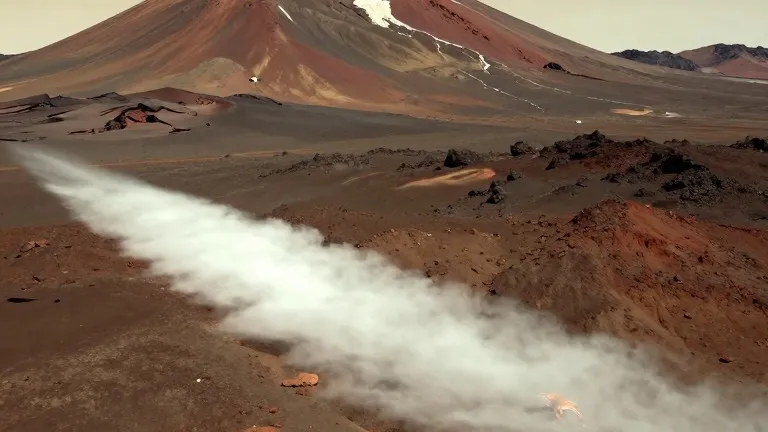
A new computer model explains how a long, thin cloud forms every morning over a volcano on Mars. The feature, called the Arsia Mons Elongated Cloud, stretches across more than 1,000 miles during Martian spring and summer. It grows longer through the morning and then disappears. This cycle repeats for several months.
Jorge Hernández-Bernal, a planetary scientist at Sorbonne Université in Paris, led the team that created the model. The study, published in Nature Geoscience, is the first to successfully reproduce the cloud’s formation in a simulation. Hernández-Bernal said the model only worked after the team included what he called “exotic physics.” He noted that this specific process appears in textbooks but is usually treated as theoretical because it is rarely thought to occur in nature.
The model relies on homogeneous nucleation. In this process, water vapor turns directly into ice crystals without needing dust or salt particles to act as seeds. On Earth, clouds form when vapor condenses onto tiny particles. Hernández-Bernal described the Martian process as “wholly unexpected,” comparing it to droplets of condensation appearing in the middle of a room rather than on a window.
Creating this type of cloud requires extreme conditions. The model shows that air temperature must drop by 30 degrees Celsius within just 10 minutes. High relative humidity is also required. The 65,000-foot Arsia Mons volcano plays a central role. When wind hits the mountain, it generates a wave that lifts moist air high into the atmosphere in minutes.
The humidity levels required are far higher than anything measured on Earth. The model suggests the Mars atmosphere contains humidity levels more than 100,000 times greater than values recorded on our planet. Scientists had not previously known that such humidity existed on Mars. Hernández-Bernal stated that far less is known about the Martian atmosphere than Earth's, making the successful reproduction of the cloud a “remarkable” result.
A probe first recorded the cloud in 2018. Since then, scientists have struggled to find a plausible explanation for its existence. The new findings suggest that similar nucleation processes might occur in the upper atmospheres of other planets, including Venus, though it has never been directly observed there. The study provides a concrete mechanism for a feature that has puzzled researchers for years.
Source: Wired