Tim McCollum Captures Halley's Comet Debris in Georgia Sky
Astrophotographer documented three Orionid meteors streaking above Toccoa on Oct. 21, recording the annual shower before its peak.
By Yasmin Duda ·
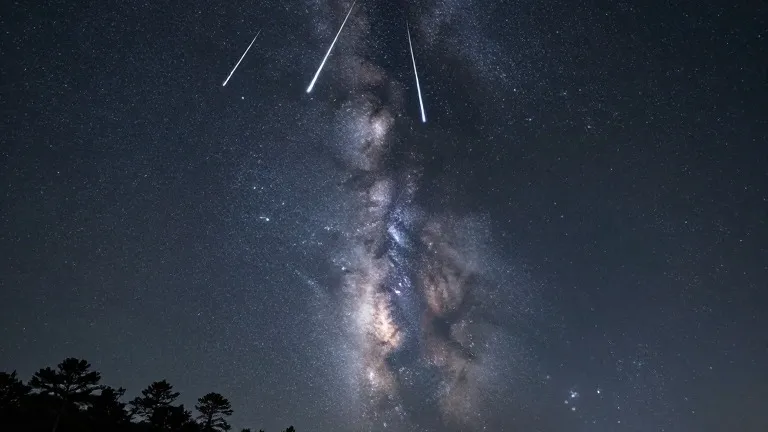
Astrophotographer Tim McCollum captured three distinct meteor trails above Toccoa, Georgia, on the night of Oct. 21. The image documents activity from the Orionid meteor shower, which is currently building toward its peak intensity. The streaks visible in the photograph are fragments of dust and rock shed by Comet 1P/Halley.
Although the comet itself remains more than 3 billion miles from Earth, the debris it left behind continues to intersect with Earth's orbit. This interaction produces the glowing trails observed during the shower. McCollum recorded the activity between 3 a.m. and 4 a.m. local time. The meteors appear to radiate from a point near Betelgeuse, a red giant star located in the constellation Orion.
The capture required precise technical execution. McCollum used a Canon EOS Ra camera paired with an RF 28-70 f2.0 lens. He employed a star tracker to maintain focus on the radiant point while taking multiple 30-second exposures. The individual frames were later combined into a single composite image using PixInsight software. This method allows photographers to preserve the brightness of the meteors while maintaining the detail of the background starfield.
The final frame contains several deep sky objects alongside the meteors. The stars of Orion's Belt appear on the right side of the image, adjacent to the glow of the Orion Nebula. This nebula is one of the closest major star-forming regions to Earth. The Rosette Nebula, catalogued as Caldwell 49, is also visible within the dense starfield and dust lanes of the Milky Way's galactic plane. Numerous star clusters are scattered throughout the diagonal band of the galactic center.
The Orionid shower remains active until Nov. 7. Observers in the coming weeks have additional opportunities to spot meteors from this stream. A secondary event may occur during this window. Earth is currently passing through debris streams from Comet 2P/Encke, which produce the Taurid meteor shower. This overlap can occasionally generate bright fireballs, sometimes referred to as Halloween Fireballs, for lucky viewers.
McCollum's photograph illustrates the visual density of the current sky conditions. The combination of meteor trails and prominent nebulae provides a clear view of the autumn astronomical landscape. The image serves as a record of the shower's early activity before the maximum rate of meteors per hour is reached.
Source: Space.com