Carney Signs Strategic Pact With Turkey Amidst Human Rights Debates
The Prime Minister defended the agreement by asserting that engaging with partners does not constitute an endorsement of their domestic policies.
By Enzo Conti ·
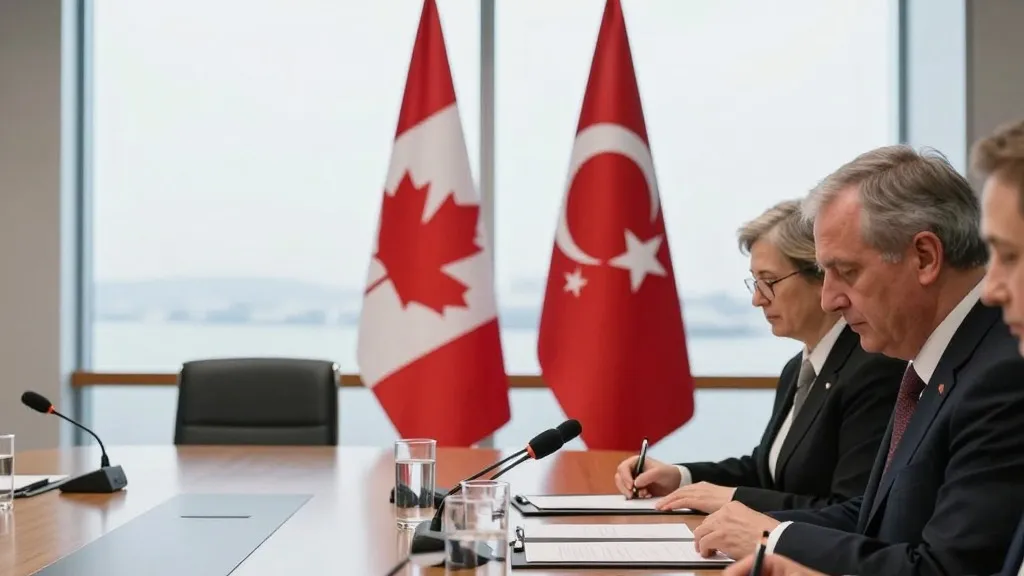
Prime Minister Mark Carney concluded a diplomatic visit to Turkey on Friday by signing a strategic partnership with the government of President Recep Erdogan. The agreement marks a significant step in Carney's efforts to diversify Canada's trade relationships, although it has drawn scrutiny due to the Turkish government's ongoing human rights challenges. Carney defended the move, stating that the decision to engage in such partnerships does not imply an approval of the partner nation's internal affairs.
The Prime Minister described the Canadian approach as values-based realism. He noted that few countries in the world can match Canada's standards, suggesting that a balance must be struck between trade interests and human rights principles. This stance allows Canada to maintain economic ties with nations that may not align perfectly with Canadian values on every issue. The strategic partnership was signed following political talks in Ankara on Thursday.
Human rights concerns have intensified in recent weeks, particularly after Turkish authorities conducted several high-profile operations. Critics argue these actions aimed to silence opposition voices, suppress independent journalism, and restrict marginalized groups. Despite this backdrop, Foreign Affairs Minister Anita Anand raised human rights issues with her Turkish counterpart during meetings on Thursday. Carney confirmed that he also addressed these concerns directly with President Erdogan, though he declined to provide specific details about the content of their private conversation.
Carney emphasized the effectiveness of direct and open dialogue between leaders, noting that such conversations are often more productive when they are not reported in full detail. He stated, "My approach on these issues is I have direct conversations with leaders." The Prime Minister's Office indicated that these discussions were part of a broader effort to maintain transparency while preserving the diplomatic relationship. The signing of the partnership reflects a broader strategy to reduce Canada's reliance on the United States market.
Economic discussions formed a central part of the visit, with Carney meeting with business leaders in Istanbul following the political talks in Ankara. One area of potential cooperation involves the sale of Canadian nuclear technology to support Turkey's climate goals. Carney indicated that there are good chances for the Canadian engineering firm AtkinsRealis to be selected as a partner for the construction of two planned power plants. This potential deal highlights the government's focus on securing new markets in sectors where Canada holds technological expertise.
The visit also provided an opportunity for Carney to address allegations regarding Canadian interference in upcoming U.S. midterm elections. On Thursday, the U.S. Embassy in Ottawa released a fact sheet formally accusing Canadian leaders of election meddling ahead of the November 3 vote. Carney responded forcefully on Friday, stating that the claims had no merit. He expressed disappointment that the U.S. envoy considered it his role to make such suggestions, while reaffirming Canada's commitment to careful diplomatic conduct.
The Prime Minister noted that Canada maintains a deep diplomatic presence in the United States and has extensive contact with American companies and citizens. He stressed that Canada is very careful to avoid appearing to interfere in the democratic process of its neighbor. As Canada continues to explore new trade partnerships in Europe, the Indo-Pacific, and other regions, the balance between economic interests and human rights values remains a central theme of the government's foreign policy strategy.
Source: CBC News
More Politics · World news · Report a business · Got a Story?