Lunar Settlements: Water Reserves Limit Population Scale
Harvard researchers calculate that the Moon's available water supports 10,000 people for centuries, but only 100,000 to 1 million for a single century.
By Yasmin Duda ·
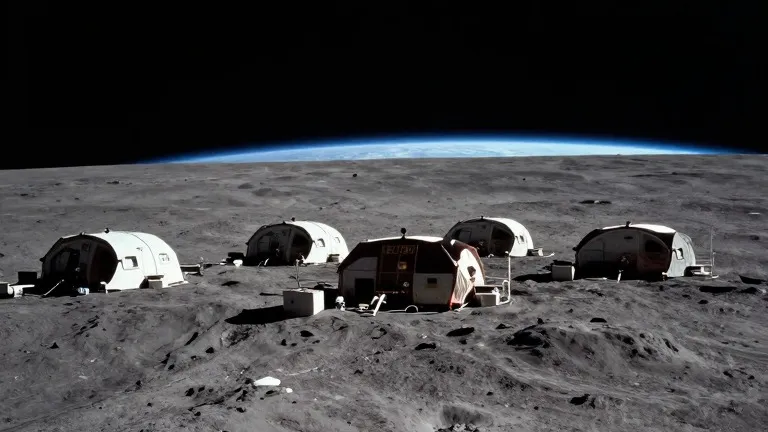
The Moon's available water supplies are insufficient to sustain large populations for extended periods, according to a new study published in Frontiers in Space Technologies.
Martin Elvis of Harvard University's Smithsonian Astrophysical Observatory and Jonathan McDowell of Durham University analyzed lunar resources to assess the feasibility of permanent settlements. Their review addresses claims made by industry leaders, including Elon Musk, who stated in February that SpaceX aims to build a self-growing city on the Moon within a decade. Jeff Bezos of Blue Origin has similarly predicted that millions will live in space by 2045.
The researchers determined that generating power for one million residents is achievable through solar and nuclear means. The limiting factor is water. Current estimates suggest approximately one billion tonnes of water exist in permanently shadowed regions at the lunar poles. Under optimal conditions, including the recycling of 98 percent of water as achieved on the International Space Station, one million people could consume this supply in roughly 100 years.
Elvis described the total volume as modest, comparing it to a small lake. He noted that such a reserve cannot support a major city for long. In contrast, a settlement of 10,000 residents could maintain sustainability for centuries using the same water resources and recycling rates.
The researchers believe the one-billion-tonne estimate may be generous. Elvis suggested the actual available amount might be 20 to 30 times smaller, with only a fraction being recoverable. His conservative estimate places usable water at about one percent of the original figure, reducing the timeline for a million-person settlement to one year.
Geological uncertainty complicates extraction. Gordon Osinski, a professor of planetary geology at Western University, noted that satellite measurements contain uncertainties. He posited that lunar water may exist as sub-millimetre ice crystals mixed into soil, resembling Arctic permafrost, which presents challenges for recovery.
McDowell emphasized that the findings clarify constraints rather than discouraging development. He stated that the data helps define what is physically possible on the lunar surface.
Source: CBC News