State Agency Plans to Let Water District Resume River Bulldozing
California Fish and Wildlife will amend its agreement with Orange County Water District, removing legal barriers to vegetation removal and sediment disturbance in the Santa Ana River.
By Yasmin Duda ·
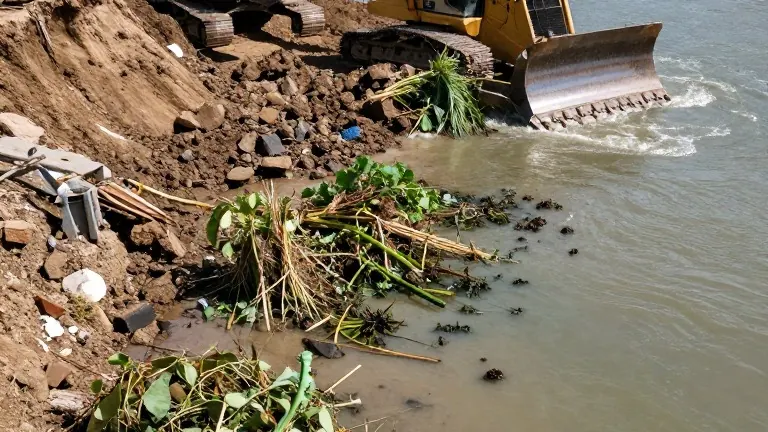
The California Department of Fish and Wildlife is preparing to amend its streambed alteration agreement with the Orange County Water District. The change will formally allow the district to continue bulldozing vegetation and moving sediment in the Santa Ana River, a practice that has sparked legal disputes and community criticism this year.
The revision addresses a technical gap in Table 2 of the current agreement. That section lists allowable maintenance activities for the river, specifically checking off work on access ramps, existing structures, and sand levees. It does not check off vegetation removal or sediment disturbance as standalone allowable activities. Fish and Wildlife stated in a Tuesday email that the creation and repair of sand levees often require the removal of non-native plants and the movement of sediment, creating confusion that the new language will resolve.
Gina Ayala, director of public affairs for the water district, defended the work in a Tuesday email. She described the removal of plant life and sediment as critical work that the agency has performed for decades. Ayala argued that the current agreement does not prohibit an activity simply because a box is unchecked in Table 2. She said the table identifies routine maintenance expected at each location, including work incidental to other authorized tasks.
The legal adjustment follows a July violation issued by Fish and Wildlife. The agency cited the water district for illegally bulldozing a migratory bird nest in the river. The district is currently contesting that violation. The backdrop for the dispute includes intense public backlash at an October 7 board of directors meeting, where residents and environmental activists questioned the use of heavy equipment to tear out growing plant life that serves as habitat for protected bird species.
Environmental groups argue the change weakens enforcement. Brent Linas, co-founder of Creek Team, said Fish and Wildlife is abdicating its responsibility by allowing the water district to proceed. He called the upcoming changes profoundly disappointing. Linas stated that the permit was intended to allow the district to absorb water incidentally and build impediments to flow, provided they did not destroy the river. He said Fish and Wildlife is now allowing the work because it is afraid to cross the district.
Kathryn Dressendorfer, Ocean Friendly Gardens program manager for the Surfrider Foundation, highlighted the physical impact of the machinery. She explained that heavy equipment compacts water-logged soil, destroying its open, spongy structure. This compaction reduces the soil's capacity to infiltrate water and act as a natural filter for pollutants, heavy metals, and bacteria. Dressendorfer also noted that bulldozer operators cannot be selective, removing native and invasive species alike rather than targeting only specific plants.
The water district disputes the impact on bird populations. Its website claims that various bird species follow the bulldozers to find food, as the routine maintenance stirs up insects and fish. Dressendorfer rejected this claim, stating that the machinery interrupts the birds' feeding time rather than attracting them. She said the birds are not following the equipment like cattle egrets in a field but are instead minding their business in the water.
Bethany Nelms, another co-founder of Creek Team, said the department has been difficult to engage. She spoke with District Attorney Todd Spitzer about the topic, and he advised her to seek an injunction, a process that can cost upwards of $10,000. Nelms asked why the agencies could not simply do what they are supposed to do.
State officials issued 2,438 lake and streambed alteration agreements between 2022 and 2025. Of those, 311 were issued to Region Five, which includes Santa Barbara, Ventura, Los Angeles, San Diego, and Orange counties. Officials said the two agencies have only begun meeting to discuss the matter. It is unknown when the changes to the agreement will go into effect.
Source: Voice of OC