Midterm Watch: Latino Turnout and the 46% Independent Threshold Decide Tuesday's Outcome
Early results from Indiana, Kentucky, and Florida will reveal Republican turnout levels, while performance in Detroit and South Texas determines which party controls the Senate and House.
By Enzo Conti ·
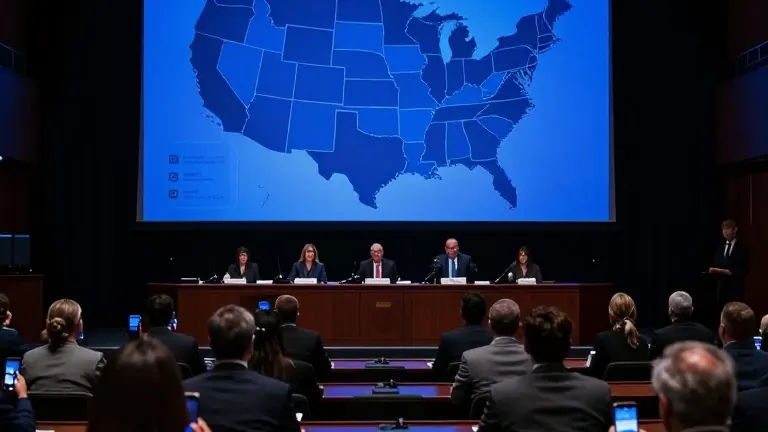
Election night will reveal which party holds the balance of power in Congress, with key indicators emerging in the early hours from specific districts and demographic groups. Voters will cast ballots for the House, Senate, and various state offices on Tuesday, November 2, 2026.
Indiana and Kentucky release results during the 6 p.m. ET hour, providing an early gauge of Republican turnout. Florida, split between time zones, will deliver most House race results by 7 p.m. ET. Watch Indiana's 5th District, Kentucky's 6th, and Florida's 22nd and 27th. If Republicans fail to hold their seats in Indiana's 5th and Kentucky's 6th, it signals weak turnout. Florida's 27th, a heavily Latino district where Donald Trump won by double digits in 2024, offers a metric for how this subgroup votes.
The independent vote is a critical swing group with lower midterm turnout. Republicans have consistently won or lost based on their share of this electorate. Since the 2016 cycle, the threshold has settled at 46%. Republicans who secured at least 46% of independent voters held ground, while those who fell short lost. This metric reflects a political realignment where blue-collar white voters trended toward the GOP and better-educated white voters shifted to Democrats.
Black voter turnout in Wayne County, Michigan, is decisive for the state's Senate race. Abdul El-Sayed (D) needs a strong showing in and around Detroit to beat the Republican challenger. Historical data shows Democrats require at least 68% of the vote in Wayne County to win statewide, unless they significantly outperform in the suburbs. Sen. Elissa Slotkin won in 2024 with 63% in the county, aided by suburban strength. If El-Sayed cannot match that suburban overperformance, he must secure a higher share of Wayne County votes.
Young voters, ages 18 to 29, experience a sharp drop in participation between presidential and midterm elections. Turnout among this group falls from 43% in presidential years to 21% in midterms. Despite low turnout, this demographic influences outcomes. Democrats have fared well when they won this group by more than 20 points. In 2022, Democrats won young voters by 28 points, limiting Republican gains to the House and allowing them to retain one Senate seat. In 2024, a 11-point margin did not prevent a Republican presidential win.
Texas presents a complex challenge for Democrat James Talarico. No Democrat has won a statewide office in Texas since 1994. Talarico must navigate a split Republican field featuring Gov. Greg Abbott and Attorney General Ken Paxton. In 2018, Ted Cruz won by over 200,000 votes despite receiving 400,000 fewer votes than Abbott. Talarico needs the gap between Abbott and Paxton to exceed 400,000 votes to have a viable path. He also must outperform Beto O'Rourke's 2018 Latino support, which stood at 64% statewide. Key counties include Cameron (63%), Hidalgo (69%), Webb (71%), and Nueces (51%).
Party identification continues to shift, with Democrats hitting a low of 31% of the electorate in 2024. This decline follows a trend of voters identifying as independent or Republican. However, high enthusiasm levels among Democrats and strong disapproval of President Trump, cited by 53% of likely voters in an NPR poll, may drive turnout. Races in Michigan, including the Senate and the 7th Congressional District, feature progressive candidates in purple areas. These contests will test the party's ideological direction as it prepares for the 2028 primary cycle.
Source: WCBE